NDIS Exercise Physiology Initial Assessment Report Template
An initial exercise physiology assessment report has to show what the participant can do now, how their disability affects it, and what exercise physiology would change. The sections below are the ones the NDIA's therapy supports guideline and its report writing guide ask for, and you can read a complete worked example on this page.
Last reviewed
What an NDIS exercise physiology assessment report is for
- A first plan, where the participant has exercise physiology funded for the first time.
- A new goal that exercise physiology would support.
- A change of circumstances, where what the participant needs has changed.
Exercise physiology and functional capacity assessment: what to claim
An exercise physiology assessment reports on movement, strength, endurance, balance and what the participant can do physically, measured with tests you can repeat.
Keep the report inside exercise physiology's scope. The NDIA's step 5 self-check asks you to confirm the request is within your scope and expertise, and a recommendation outside it is one of the common reasons a request is questioned.
Template sections
- Participant details, including the NDIS number.
- Disability, in one line and in plain words.
- Plan goals, in the participant's own words.
- Previous treatment and what it achieved.
- Subjective: what the participant reports about pain, fatigue, confidence and daily life.
- Objective: what you measured and observed, with the measures named in full.
- What the sessions will involve, described as activities rather than as a protocol.
- Expected outcomes, naming a measure and a target where you can.
- Other supports, formal and informal.
- How the support relates to the disability rather than to general fitness.
- Why an Accredited Exercise Physiologist, rather than another option.
- Whether the purpose is to build capacity or to maintain function, and why.
- The risks if the supports are not provided.
- Consent, and whether a copy was given to the participant.
Choosing outcome measures for an initial assessment
Pick measures you can repeat at the next report, so the progress report has a baseline to compare against. epnote keeps each measure's unit, decimals and direction from its own library, so a value never loses its unit between reports.
Worked example
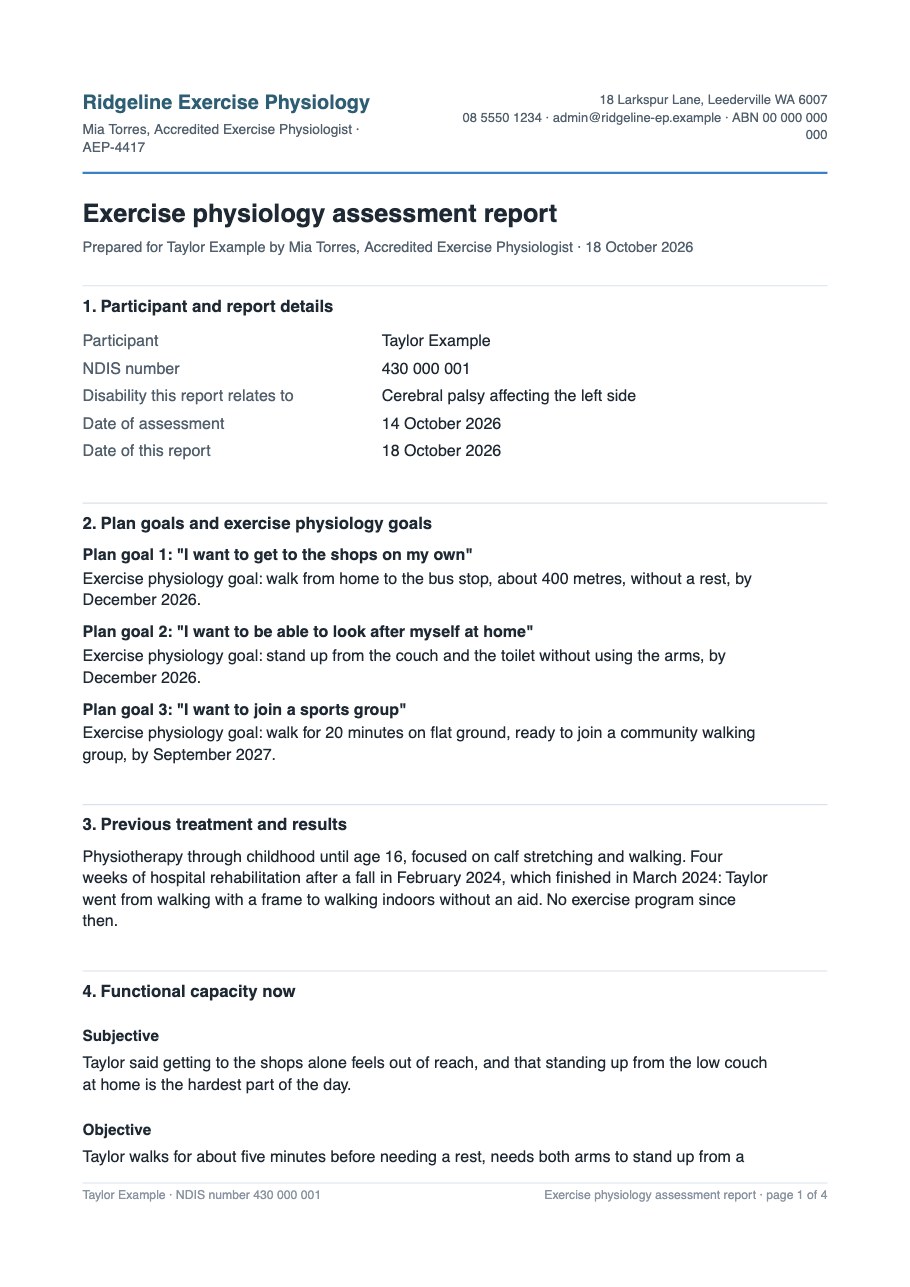
A complete NDIS initial assessment report, rendered by epnote from a fictional participant.
Writing in plain words
- Write for a reader with no health background, and use the participant's name.
- Write test names in full. If an abbreviation cannot be avoided, define it the first time you use it.
- Write units in words: seconds, metres.
- Put the change in daily life before the number. For example: now walks to the bus stop without a rest, and six-minute walk distance rose from 310 to 420 metres.
- State requests in hours, not dollars. ESSA's guidance is that a request should give the number of hours rather than the cost.
- Write dates as 16 October 2026 in text, and 16/10/2026 only inside a table.
- Make no claim about meeting any funder's requirements anywhere in the report.
Questions
- What is included in an NDIS exercise physiology assessment?
- The participant's disability and how it affects what they can do, their plan goals, what you measured objectively, what they report subjectively, what the sessions would involve, the expected outcomes with a measure and a target where possible, the other supports involved, how the support relates to the disability, and the risks if it is not provided.
- Can an exercise physiologist do a functional capacity assessment for the NDIS?
- An exercise physiologist assesses and reports on physical function: movement, strength, endurance, balance and what the participant can physically do. Keep the report to that. The NDIA asks you to confirm any request is within your own scope and expertise.
- How does NDIS exercise physiology work?
- A participant with exercise physiology funded in their plan is assessed by an Accredited Exercise Physiologist, who writes an assessment report supporting the supports being asked for, delivers the sessions, and reports progress before the plan is reassessed.
- Which outcome measures should an exercise physiologist use in an NDIS initial assessment?
- Measures that relate to the participant's goals and that you can repeat. The measures library on this site lists what each one records, and which of its change thresholds have been checked against their primary papers.
- Does the participant need a GP referral for NDIS exercise physiology?
- The NDIS does not work through GP referrals the way Medicare does. What matters is that exercise physiology is funded in the participant's plan. A GP letter can still be useful clinical background.
Write this report in epnote, free
epnote is report software for Australian exercise physiologists. Enter your measurements once and it works out the change and lays the report out, ready to sign. What you write about a client stays on your device.
Write this report in epnote, freeRelated
Sources
Everything on this page comes from one of these. epnote writes nothing clinical from memory.
- epnote NDIS EP report template research, 20 October 2026, which cites the NDIA plan reassessment guidance, the NDIA report writing guide, the NDIA therapy supports guideline and ESSA's NDIS report writing guidelines
docs/research/ndis/ndis-ep-report-templates-2026-10-20.md - NDIA, Therapy supports guideline https://ndis.gov.au/media/8091/download?attachment
- ESSA, Report writing guidelines for NDIS participants https://www.essa.org.au/Web/Web/Resources/Tools-and-templates/report-writing-guidelines-for-NDIS-participants.aspx
- epnote report style benchmarks, which set the plain-language and layout rules these templates follow
docs/research/report-style-benchmarks.md
Get new templates and guides
One email when a new template or guide goes up. Your address, nothing else, and you can stop at any time.