NDIS Exercise Physiology Progress Report Template (Plan Reassessment)
A plan reassessment report tells the NDIA what changed, what it took, and what the participant needs next. The sections below are mapped one to one against the NDIA's own plan reassessment guidance, so nothing it asks for is left out. You can read the full worked example on this page before you write one.
Last reviewed
When an NDIS progress or plan reassessment report is needed
A plan reassessment report is written before a participant's plan is reassessed, and a progress report is written when the NDIA asks for one or when the participant wants their progress recorded part way through a plan.
The report goes to the participant, who decides who else sees it. It is uploaded to the provider portal only with their consent.
- Before a scheduled plan reassessment, to support the supports being asked for in the next plan.
- When the NDIA requests a report during a plan.
- On a change of circumstances, when what the participant needs has changed.
- At the end of a service, as a discharge summary.
What the NDIA looks for, section by section
The NDIA's plan reassessment guidance is a series of steps, and each step asks for something specific. This table is epnote's own mapping of every element in that guidance to the section of the report that answers it. The epnote NDIS progress report is built from this mapping.
| What the NDIA asks for | Where it goes |
|---|---|
| Outcomes achieved during the reporting period | Goal progress |
| Type of service, therapeutic approach, duration and frequency | Service delivered |
| Goals worked towards, and the intended outcome | Goals |
| Functional capacity at the start, and the assessment measures used | Functional capacity |
| Evidence of therapies already trialled | Service delivered |
| Progress towards goals, with measures | Goal progress |
| Barriers, how they were addressed, and why an outcome was not achieved | Barriers |
| Risks, and how they were addressed | Risks |
| Other NDIS, informal, community and mainstream supports | Other supports |
| Supports recommended for the next period, and expected progress | Recommendations |
| Justification, expected outcomes, and risks or impacts on other supports | Recommendations and reasoning |
| Whether the request is within your scope and expertise | Reasoning |
| Sharing with the participant, and portal upload with consent | Consent |
Template: section by section
This is the structure epnote's NDIS progress report uses. Each heading below is a section of the document, in the order it prints.
- Participant details: name, date of birth, NDIS number and the reporting period.
- Goals: the participant's plan goals, in their own words, and the exercise physiology goals that support each one.
- Service delivered: the type of service, the therapeutic approach, how often and for how long.
- Functional capacity: what was measured, subjectively and objectively, with baseline against current.
- Goal progress: each goal, what the participant reports has changed, and what you measured or observed.
- Barriers: what got in the way, what you changed, and why a goal was not reached.
- Risks: what the risks are and how they were managed.
- Other supports: family, community, mainstream and other NDIS supports.
- Recommendations: the supports recommended next, in hours, with the reasoning and the expected outcome.
- Consent: that a copy was given to the participant, and whether they consented to a portal upload.
Worked example
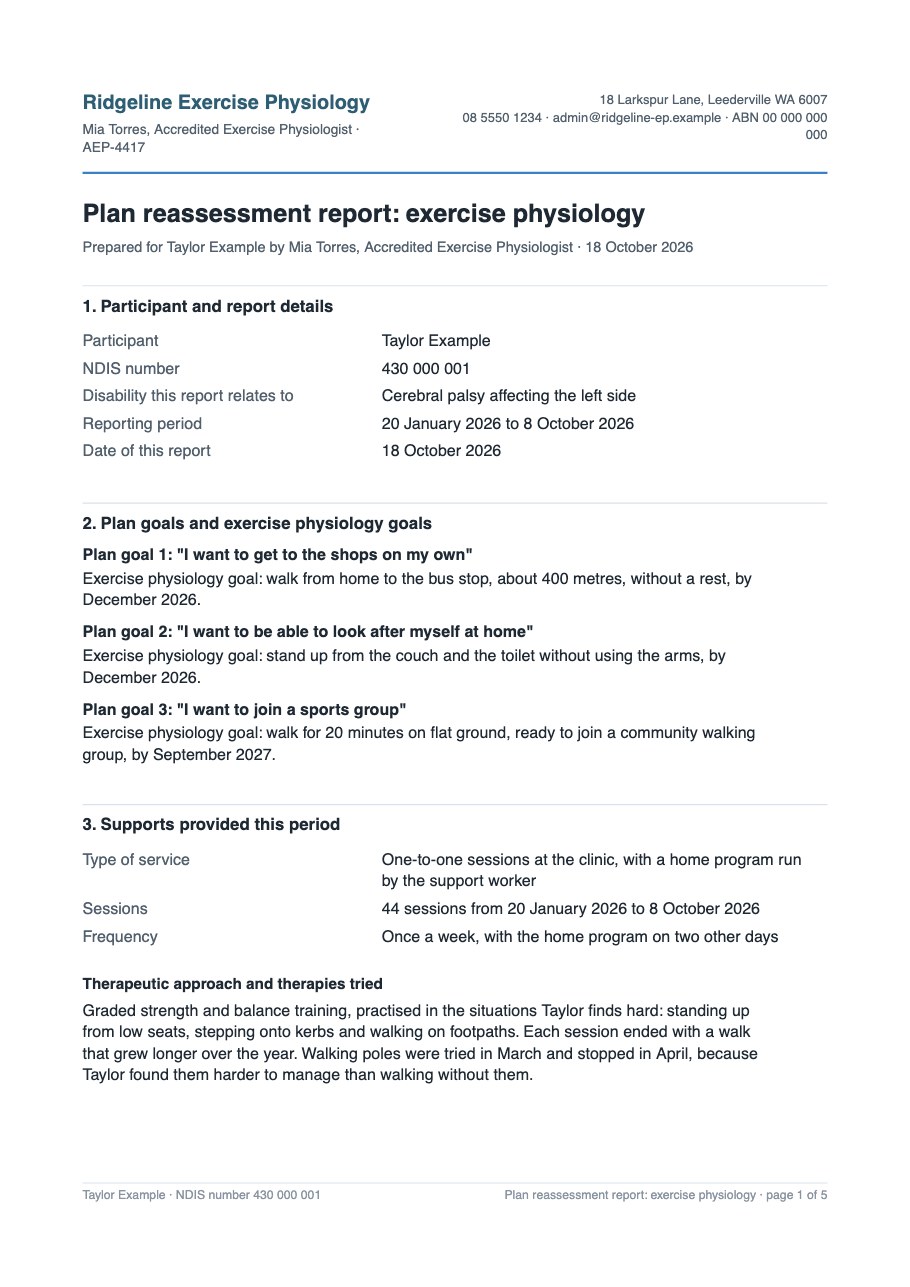
This is a complete NDIS progress report rendered by epnote from a fictional participant. Every number in it came from the measurements entered once; the clinical reasoning is written by the exercise physiologist.
Writing recommendations the NDIA can act on
Three rules from the NDIA's own therapy supports guideline shape what you can ask for, and they are the usual reasons an exercise physiology request is questioned.
- Ask in hours, not dollars. ESSA's guidance is that a request should give the number of hours rather than the cost.
- A gym or pool membership is not an NDIS support. The NDIA will not fund the cost of access or a membership, so leave those out of recommendations.
- General fitness, weight loss and exercise are excluded as not specifically disability related. Tie every recommendation to the disability and to a plan goal.
- The credential the NDIA names is an Accredited Exercise Physiologist with Exercise and Sports Science Australia, which is an accreditation rather than a national registration.
Writing in plain words
These are the language rules epnote's NDIS reports follow, drawn from ESSA's guidance and the Australian Government Style Manual.
- Write for a reader with no health background, and use the participant's name.
- Write test names in full. If an abbreviation cannot be avoided, define it the first time you use it.
- Write units in words: seconds, metres.
- Put the change in daily life before the number. For example: now walks to the bus stop without a rest, and six-minute walk distance rose from 310 to 420 metres.
- State requests in hours, not dollars. ESSA's guidance is that a request should give the number of hours rather than the cost.
- Write dates as 16 October 2026 in text, and 16/10/2026 only inside a table.
- Make no claim about meeting any funder's requirements anywhere in the report.
Common reasons an exercise physiology report gets questioned
- The recommendation is not linked to a plan goal.
- The request is in dollars rather than hours.
- The report asks for something outside exercise physiology's scope.
- A gym or pool cost is included.
- The reasoning reads as general fitness rather than disability related.
- There is no baseline to compare the current measurements against.
Questions
- How do you write an NDIS exercise physiology progress report?
- Work through the NDIA's plan reassessment steps in order: what the goals were, what service you delivered, what the participant's functional capacity was at the start, what progress you measured against each goal, what got in the way, what the risks are, what other supports are involved, and what you recommend next in hours. The mapping table on this page shows which section answers each element.
- What should be included in an NDIS plan reassessment report?
- The NDIA's guidance asks for outcomes achieved, the service delivered with its approach and frequency, functional capacity at the start with the measures used, progress against each goal, barriers and how you addressed them, risks, other supports, and the supports recommended for the next period with their justification and expected outcomes. It also asks you to confirm the request is within your scope.
- How long should an NDIS exercise physiology report be?
- There is no length the NDIA sets. What it asks for is that every element in its guidance is answered. A report that answers all of them clearly is the right length, and epnote prints only the sections you have answered, so nothing empty pads it out.
- Can I bill the NDIS for report writing time as an exercise physiologist?
- Report writing is claimed through the non-face-to-face and NDIA requested report suffixes on the exercise physiology line items, not as a separate item. The exact claiming rules for 2026-27 are set by the NDIA's pricing arrangements, which is the document to check rather than any summary.
- What outcome measures should an exercise physiologist include in an NDIS report?
- Use measures that speak to the participant's goals and that you can repeat at the next report, so there is a baseline to compare against. The measures library on this site lists what each measure records and which change thresholds have been checked against their primary papers.
- When should a plan reassessment report be submitted?
- Before the plan reassessment meeting, with enough time for the planner to read it. The NDIA's guidance does not set a fixed number of days, so check the date on the participant's own reassessment notice.
Write this report in epnote, free
epnote is report software for Australian exercise physiologists. Enter your measurements once and it works out the change and lays the report out, ready to sign. What you write about a client stays on your device.
Write this report in epnote, freeRelated
Sources
Everything on this page comes from one of these. epnote writes nothing clinical from memory.
- epnote NDIS EP report template research, 20 October 2026, which cites the NDIA plan reassessment guidance, the NDIA report writing guide, the NDIA therapy supports guideline and ESSA's NDIS report writing guidelines
docs/research/ndis/ndis-ep-report-templates-2026-10-20.md - NDIA, How to write a plan reassessment report https://www.ndis.gov.au/providers/working-participants/allied-health-professionals/how-write-plan-reassessment-report
- NDIA, Therapy supports guideline https://ndis.gov.au/media/8091/download?attachment
- ESSA, Report writing guidelines for NDIS participants https://www.essa.org.au/Web/Web/Resources/Tools-and-templates/report-writing-guidelines-for-NDIS-participants.aspx
- epnote report style benchmarks, which set the plain-language and layout rules these templates follow
docs/research/report-style-benchmarks.md
What this page does not cover yet
- The brief asks for the NDIA's plan reassessment Steps 3, 5 and 6 to be copied verbatim before release. The repo's research records what each step asks for but not its exact wording, so this page paraphrases and cites the NDIA page instead.
Get new templates and guides
One email when a new template or guide goes up. Your address, nothing else, and you can stop at any time.